A positive direction for a changing century.
A more resilient, cooperative, truthful, ecologically viable, and life-affirming future remains possible—and people are already building it.
Every restored ecosystem, protected community, honest lesson, useful skill, improved institution, courageous conversation, and tested solution can become part of something larger. We call that larger possibility Humanity's Great Rebirth.
The Great Rebirth Network is the clearest name for the broad, voluntary movement connecting people, communities, organizations, and projects that are helping better futures become more likely. It is not one organization directing everyone else. It is a learning network in which many contributors can test ideas, share results, correct mistakes, and build what works.
You can enter through the need that matters most to you: greater clarity, practical preparedness, protection of people and nature, meaningful contribution, trustworthy community, or a deeper sense of purpose. You do not have to solve everything or adopt a new identity before taking one useful step.
Choose your reading depth: read the positive short version for about one minute; continue through the movement and four-site pathway for about five minutes; or follow every section for the complete framework.

On this page
Prologue: Begin with the Future We Want to Help Build
The Great Rebirth is a practical invitation to protect the best of civilization, repair what can be repaired, replace what repeatedly causes harm, and leave wider possibilities to those who come after us.
You do not need to begin with a complete theory of civilization. Start with the benefit, question, or need that speaks to you.
Clarity
Understand complex change without surrendering to panic, denial, propaganda, or manufactured certainty.
Readiness
Strengthen practical options before disruption makes preparation harder, more expensive, or impossible.
Protection
Protect people, dignity, rights, knowledge, communities, ecosystems, and essential services.
Agency
Find meaningful work at the scale you can influence instead of waiting for perfect leaders or total certainty.
Belonging
Connect with people who value evidence, pluralism, cooperation, accountability, learning, and service.
Purpose and joy
Turn concern into contribution while preserving beauty, play, friendship, wonder, and reasons to want the future.
Begin with the destination. Face reality. Build the path.
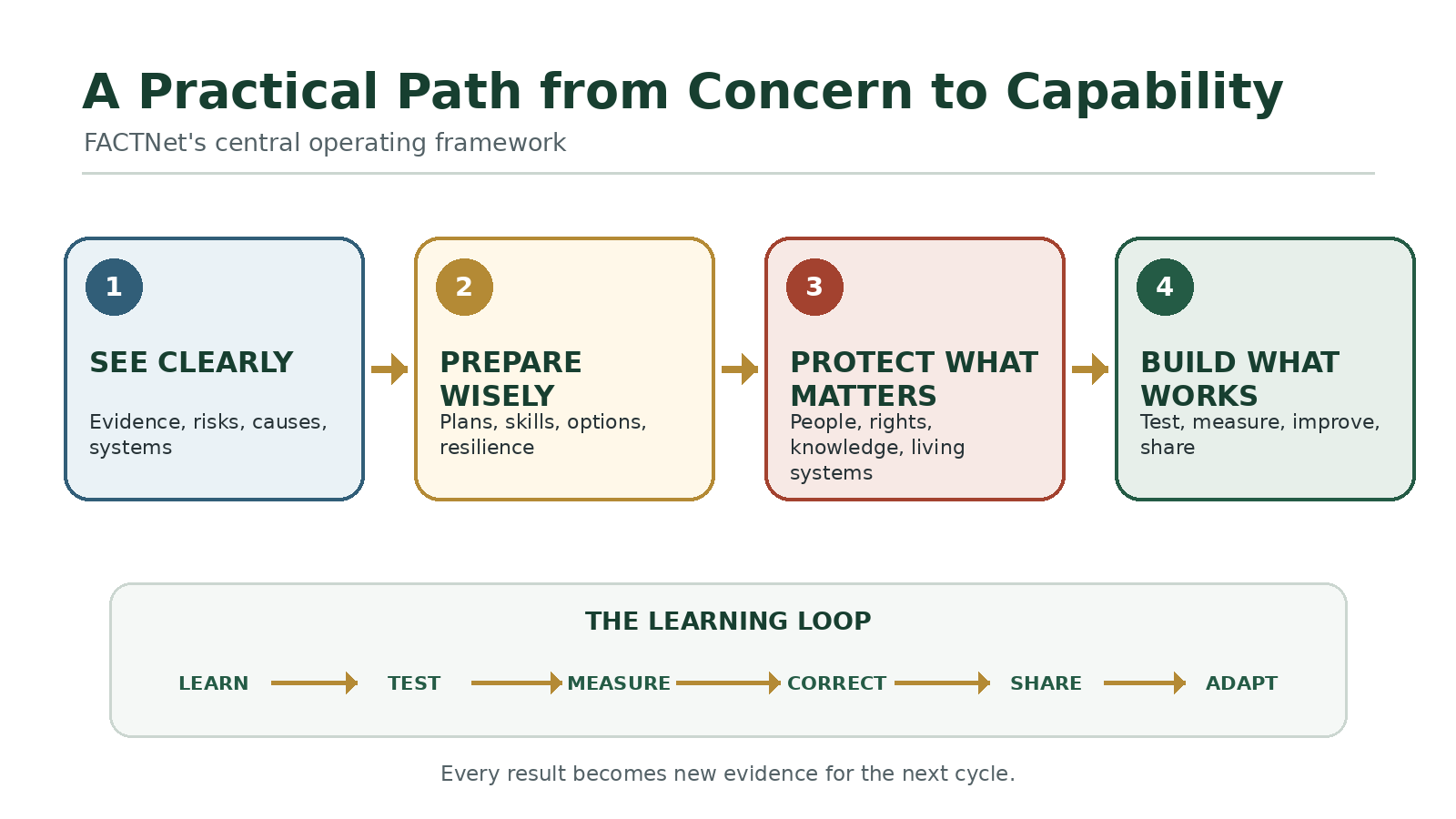
The positive short version: See what can still be protected and built. Learn what threatens it. Prepare without panic. Reduce avoidable harm. Strengthen cooperation. Test solutions. Correct errors. Share what works.
What we mean by “rebirth”
A period of renewal in which something damaged, declining, or no longer adequate is transformed into new growth, development, resilience, and possibility.
What we mean by “reckoning”
An honest accounting of reality in which we recognize what has happened, understand its causes and consequences, and face what those facts require us to change.
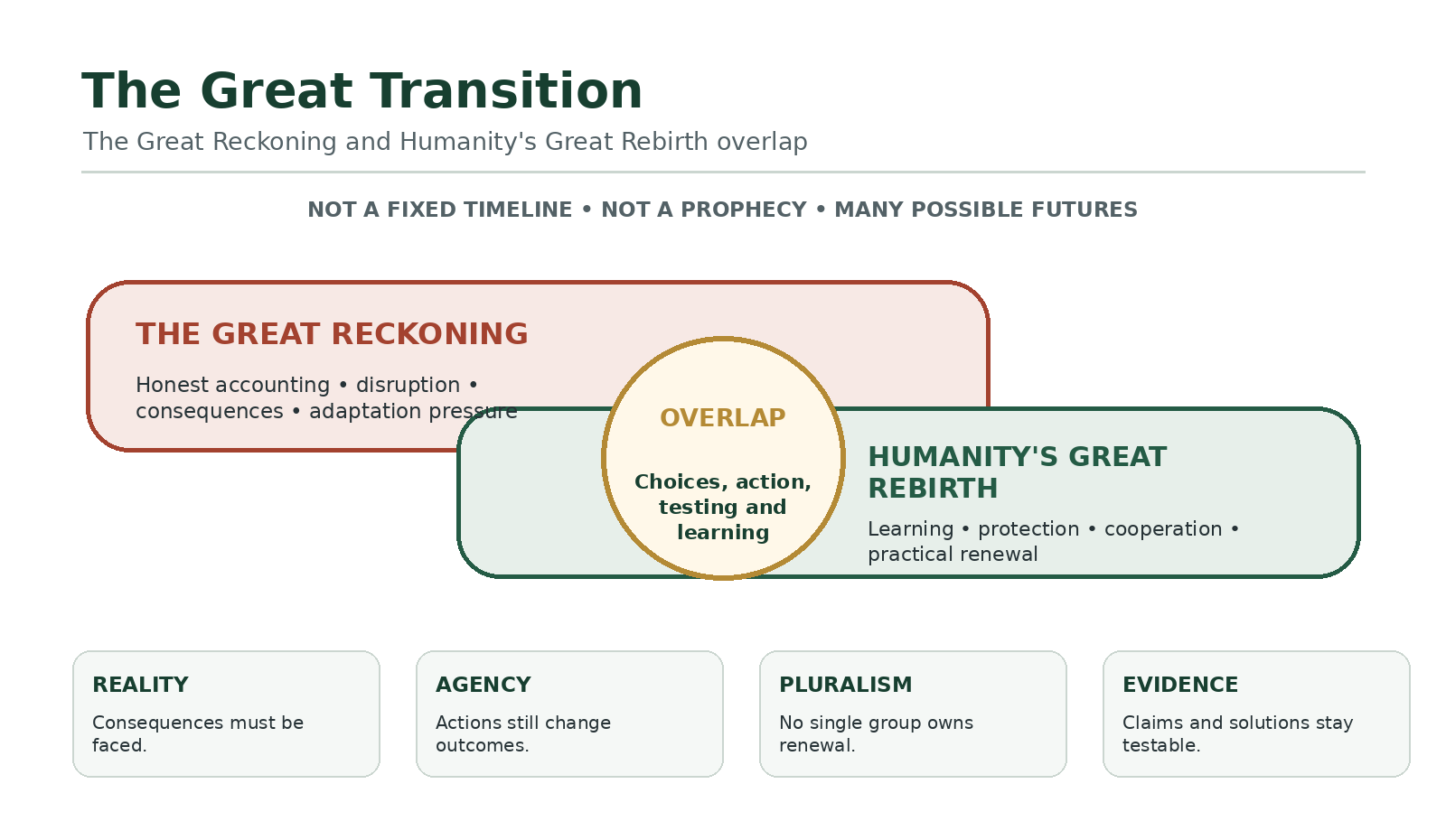
Rebirth is reality-based renewal, not wishful optimism. Reckoning is reality recognition, not the destination. The two processes overlap because constructive adaptation can begin while serious consequences are still unfolding.
1. What Is Humanity's Great Rebirth?
Humanity's Great Rebirth is our name for the overlapping historical process through which people, communities, institutions, and societies preserve what is best in civilization while replacing patterns that repeatedly generate ecological overshoot, conflict, exploitation, fragility, misinformation, dysfunction, injustice, and systemic crisis.
Working definition
Humanity's Great Rebirth is the long-term, overlapping process of creating societies that are more truthful, cooperative, ecologically responsible, resilient, just, adaptive, life-affirming, and capable of learning from consequences.
It includes institutions that align incentives with the long-term common good; make decision-makers more accountable for the effects of their actions; support genuine contributors; limit commons exploitation and deliberate free-riding; protect shared resources; strengthen cooperation from local to global scales; and preserve human dignity, knowledge, freedom, and meaningful agency.
Survival is necessary, but survival alone is not a sufficient vision. A society can survive while becoming more authoritarian, unequal, ecologically destructive, ignorant, or violent. The Great Rebirth therefore asks a harder and more useful question: What forms of civilization can remain viable while also being worth preserving?
The Great Reckoning is the process of seeing clearly, understanding honestly, and confronting what can no longer continue. The Great Rebirth is the constructive process of using that understanding to create what can and should come next.
A project, not a promise
The Great Rebirth is a possible achievement, not destiny. Evolutionary progress is conditional and reversible. Societies can stagnate, regress, fragment, collapse, become authoritarian, or repeat failed patterns. Better outcomes require deliberate learning, responsible preparation, sound institutional design, practical experimentation, and sustained cooperation.

2. The Great Rebirth Network: The Movement That Helps Better Futures Grow
The Great Rebirth Network is the clearest name for the broad, voluntary movement of people, communities, organizations, and projects working to make more viable and life-affirming futures possible.
“Great Rebirth” names the positive direction. “Network” describes how the work grows: through many disciplines, cultures, locations, institutions, and experiments learning from one another without pretending that one center can command a civilization-scale transition.

What participants do
- Learn from evidence, experience, local knowledge, and responsible disagreement.
- Prepare people and communities without spreading panic.
- Protect life, dignity, rights, knowledge, freedom, and living systems.
- Build and test useful projects, policies, practices, and institutions.
- Measure results, admit mistakes, improve methods, and share what works.
Safeguards against misuse
- Not a political party, religion, sect, or closed ideology.
- Not a claim that one person, website, or group owns the truth.
- Not a promise that progress is automatic or inevitable.
- Not a substitute for democratic accountability, professional expertise, or local knowledge.
- Not permission to devalue people who do not join, use our language, or agree with every conclusion.
A movement held together by practice
The network is voluntary, pluralistic, evidence-responsive, and open to contribution. Participants do not need one metaphysical worldview or political identity. They need enough shared commitment to learn honestly, protect dignity, cooperate on real problems, and correct their work when results or evidence require it.
What is an Evolutioneer?
An Evolutioneer is a person committed to continuous learning, reality-based and metasystemic thinking, responsible preparation, protection of human dignity and living systems, practical contribution, and correction through results.
The identity connects the Great Reckoning with the Great Rebirth: an Evolutioneer is willing to recognize serious problems, learn from them, develop useful capabilities, and apply that learning to constructive renewal.
Practice before identity
Problem → Learning → Capability → Contribution → Optional Identity

You do not have to call yourself an Evolutioneer to participate. The word is an invitation and a direction of practice—not a rank, doctrine, claim of superiority, spiritual attainment, moral badge, or test of human worth. Contribution matters more than adopting a label.
You may already be doing this work if you are understanding risks honestly, preparing responsibly, protecting people or ecosystems, improving institutions, teaching useful skills, correcting mistakes, creating joy and meaning, or leaving better options to those who come after you.
3. One Mission, Four Public Doorways
FACTNet is the nonprofit umbrella connecting a four-website public-education pathway. People can enter through the need that matters most and move among the sites as their questions and capacities develop.
Survive and Stabilize → Think Clearly → Live Wisely → Mean Deeply
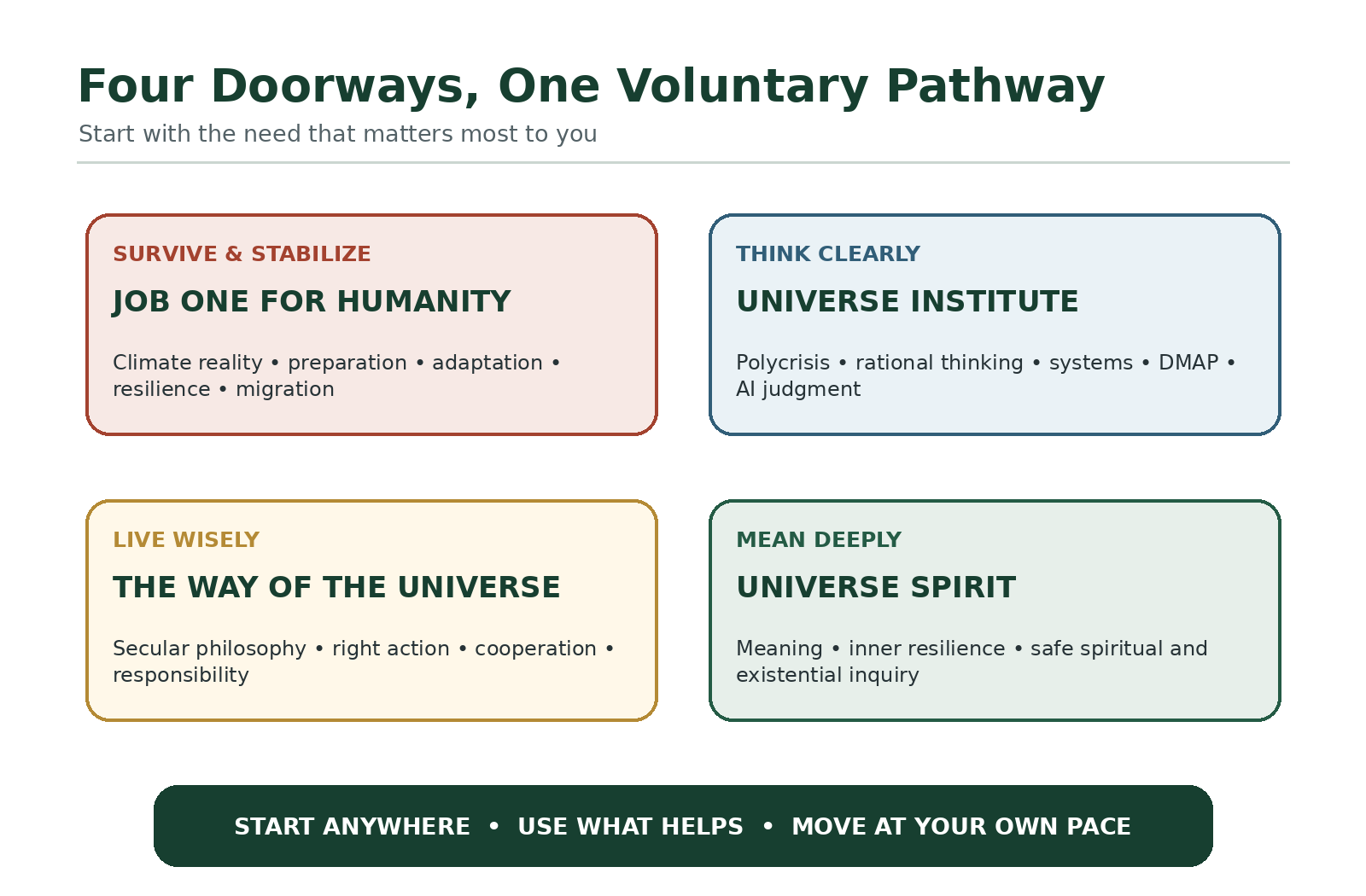
This is a pathway, not a ladder. No doorway is “higher,” and no visitor must use all four.
Job One for Humanity
Survive and stabilize. Understand climate realities and deadlines; reduce climate risk; and prepare for adaptation, resilience, migration, and protection of essential systems.
Universe Institute
Think clearly. Understand the global polycrisis, use rational and systems thinking, learn Dialectical Metasystemic Analysis and Problem-Solving (DMAP), and develop wiser judgment about AI and civilization.
The Way of the Universe
Live wisely. Explore a secular practical philosophy aligned with reality, evolution, ecological limits, Right Actions, Right Attitudes, responsibility, and the common good.
Universe Spirit
Mean deeply. Explore wonder, belonging, inner resilience, and safe spiritual or existential inquiry without surrendering balance, critical thinking, pluralism, or freedom.
Each doorway develops a different capacity the Great Rebirth needs. Together they connect reality, understanding, better thinking, preparation, wise action, cooperation, meaning, and renewal.
4. Related Ideas: Great Turning, Great Transition, Great Transformation, Great Simplification, and Regeneration
Several traditions describe constructive transformations that overlap with the Great Rebirth. They are related concepts, not interchangeable labels. Naming the differences helps us learn from each tradition without pretending they all say the same thing.
| Term | Primary emphasis | Relationship to the Great Rebirth vision |
|---|---|---|
| Great Turning | Movement from an industrial growth society toward a life-sustaining society. | Closely parallels the cultural and ecological transformation dimension. |
| Great Transition | Long-range movement toward a just and sustainable planetary civilization. | Strongly overlaps with global institutional and civilizational transformation. |
| Great Transformation | Large-scale restructuring of economies and societies toward sustainability. | Overlaps with economic, technological, and institutional redesign. |
| Regenerative civilization | Systems that restore ecological and social capacity rather than merely reducing damage. | A central ecological and social aspiration of the Great Rebirth. |
| Ecological civilization | Society organized around ecological limits and human-nature interdependence. | Provides a family of ecological-governance models, although definitions vary. |
| Post-growth or degrowth transition | Reducing dependence on perpetual material and energy-throughput growth. | Relevant where ecological viability requires lower throughput, but the Rebirth is broader than one economic doctrine. |
| Resilience transition | Building capacity to withstand shocks and adapt. | Necessary but insufficient: a harmful system can also be resilient. |
| Great Simplification | Nate Hagens' term for a likely transition from energy-intensive, growth-dependent civilization toward simpler, lower-energy systems as ecological and resource constraints tighten. | One probable material dimension of the Great Reckoning and an important condition the Great Rebirth must navigate. |
How the three-part relationship fits together
The Great Reckoning describes the wider period of converging disruption driven by climate change, ecological overshoot, resource constraints, economic and political instability, institutional stress, technological risk, and other interacting polycrisis forces.
The Great Simplification focuses more specifically on the likelihood that high-energy, growth-dependent, materially complex societies will be forced toward lower-energy and less resource-intensive forms.
The Great Rebirth is the broader constructive response: using this difficult transition to build societies that are more resilient, cooperative, ecologically sustainable, truthful, and capable of living within real limits rather than repeatedly discovering that physics does not negotiate.
5. Twelve Core Principles of the Great Rebirth
These principles are design tests, not ideological purity tests. A project can begin imperfectly, learn from results, and improve.
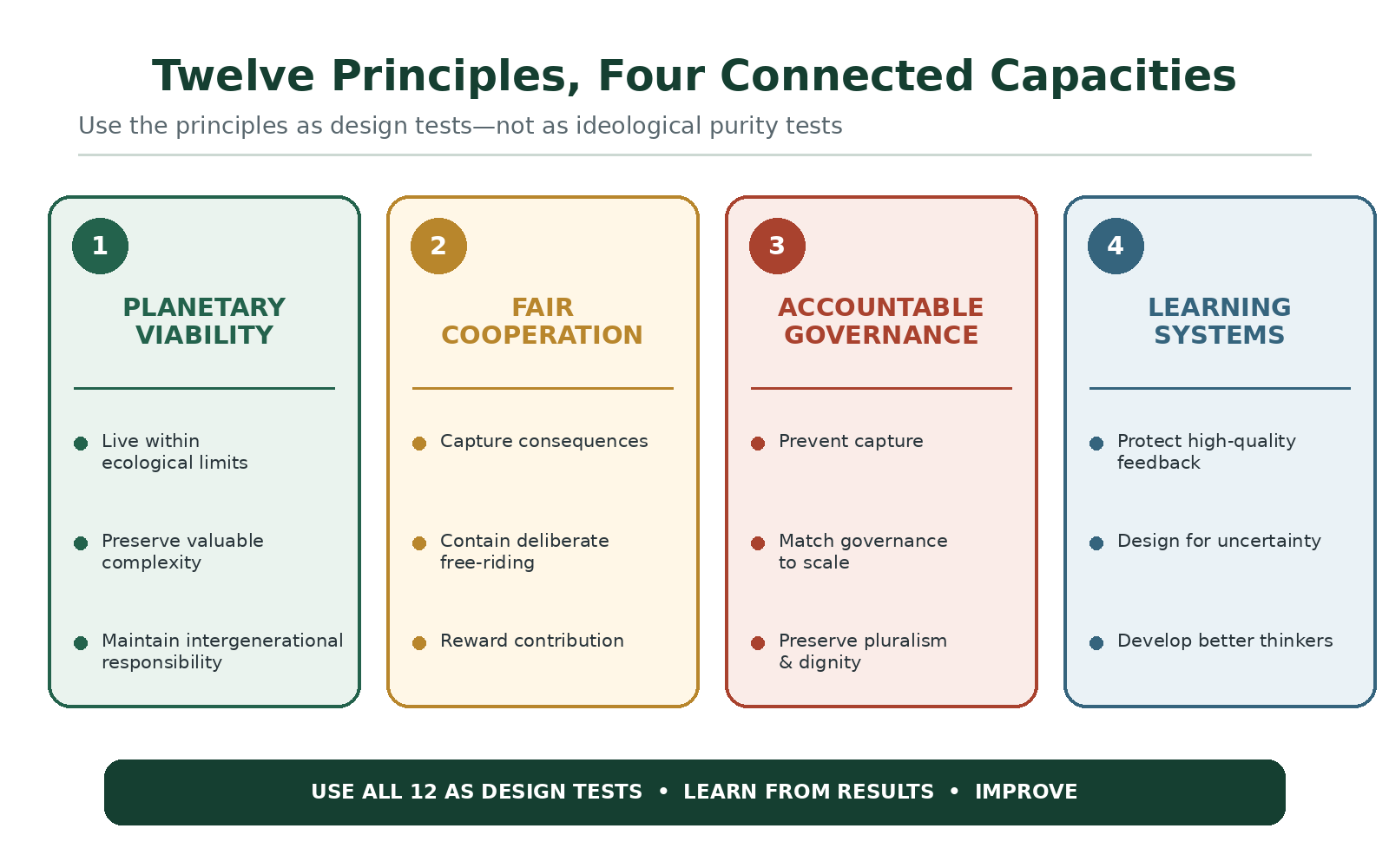
- Live within ecological limits. Civilization must fit inside the regenerative capacity and stability ranges of the biosphere that supports it.
- Capture consequences. Powerful actors should not be able to take benefits while exporting significant costs to other people, future generations, or ecosystems.
- Contain deliberate free-riding. Durable cooperation requires fair mechanisms that prevent systematic exploitation of contributors and commons.
- Reward contribution. Systems should make pro-social, regenerative, and truth-seeking behavior viable rather than depending on permanent heroism.
- Prevent capture. Rules need independent oversight, transparency, distributed checks, enforceable conflict-of-interest limits, and pathways for correction.
- Protect high-quality feedback. Institutions must be able to hear bad news, detect errors, and change course without punishing the messenger.
- Match governance to scale. Local problems should not automatically be centralized, and planetary commons cannot be solved by isolated localism.
- Preserve pluralism and dignity. Cooperation must not become an excuse for coercive uniformity or unequal human worth.
- Design for uncertainty. Use scenarios, margins of safety, redundancy, reversible experiments, and adaptive rules.
- Preserve valuable complexity. Science, medicine, communication, rights, and critical infrastructure deserve protection even if other systems must simplify.
- Develop better thinkers. A civilization's decision quality cannot permanently outrun the thinking quality of the humans and institutions making those decisions.
- Maintain intergenerational responsibility. Future people and ecosystems need representation in present decisions because they receive consequences without voting on them.

6. Governance for a Cooperative Civilization
Evolution repeatedly creates higher-order cooperation only when mechanisms emerge that constrain destructive competition within the cooperative unit. Human civilization needs institutions that can do the same without extinguishing legitimate competition, creativity, freedom, disagreement, and diversity.
Consequence capture
Polluters, financial decision-makers, political leaders, platforms, corporations, and other powerful actors should experience meaningful consequences when their decisions impose major harms. Liability, pricing, regulation, disclosure, insurance, bonding, and reputation systems can all contribute.
Commons integrity
Shared resources require clear boundaries, measurement, transparent rules, verification, proportionate enforcement, conflict resolution, anti-capture protections, and adaptation as conditions change.
Governance closure
Any rule system can fail if regulated actors can capture the regulator, hide information, buy exemptions, or rewrite enforcement. Safeguards must close predictable escape routes.
Polycentric governance
Many problems are best managed through nested institutions: local experimentation and accountability connected to regional, national, and global coordination where scale demands it.
Legitimacy as stability technology
Rights, fairness, transparency, due process, and public participation are not decorative moral luxuries. They can increase trust and voluntary compliance while reducing the coercive overhead required to hold societies together.
Adaptive institutions
Rules should contain review points, measurable outcomes, sunset clauses where appropriate, error-correction procedures, and mechanisms for incorporating new evidence.

7. A Second Enlightenment: Better Thinking for Harder Problems
The first Enlightenment elevated evidence, reason, science, rights, and individual freedom. Humanity's Second Enlightenment and Great Rebirth require extending those achievements with thinking tools suited to complex adaptive systems such as economies, ecosystems, political systems, cultures, technologies, and their interactions.
Systems thinking
Feedback loops, delays, thresholds, emergence, stocks and flows, resilience, dependencies, and unintended consequences.
Dialectical and metasystemic thinking
Process, relationship, context, transformation, contradiction, and the ability to hold interacting truths without collapsing into simplistic either-or categories.
Probabilistic reasoning
Make decisions under uncertainty instead of demanding impossible certainty before acting.
Evidence literacy
Distinguish primary evidence, synthesis, expert judgment, advocacy, inference, speculation, uncertainty, misinformation, and disinformation.
Bias and incentive analysis
Understand how career, institutional, economic, political, media, algorithmic, and psychological incentives shape what information is produced and amplified.
Experiential competence
Convert declarative knowledge into practiced judgment through repeated application, feedback, reflection, correction, and real-world service.
AI should expand thinking—not replace judgment
AI can compare evidence, generate hypotheses, expose omissions, model scenarios, summarize research, and red-team proposals. Users should still demand sources, counterarguments, uncertainty ranges, incentive analysis, and falsification criteria. A civilization that outsources judgment to persuasive machines would be a remarkable technological achievement in the avoidance of adulthood.

8. Economy Inside Ecology—not Ecology as an Economic Subcategory
The Great Rebirth begins with an unfashionable accounting reality: the economy is a subsystem of the biosphere. Money, debt, and prices can be created institutionally. Stable climate regimes, fertile soils, functioning oceans, biodiversity, fresh water, and concentrated mineral deposits cannot.
| Design goal | Practical implication |
|---|---|
| Reduce ecological overshoot | Measure material and ecological throughput directly, not only monetary output. |
| Protect minimum human wellbeing | Do not make ecological transition depend on sacrificing those with the least capacity to absorb shocks. |
| End destructive externalization | Internalize major pollution, depletion, climate, biodiversity, and human costs where practical. |
| Favor durability and repair | Make long-lived, maintainable products and infrastructure economically sensible. |
| Build strategic resilience | Balance efficiency with redundancy, local capacity, diversified supply, and emergency reserves. |
| Preserve useful innovation | Direct technological creativity toward human wellbeing and lower ecological burden rather than throughput for its own sake. |
| Reward restoration | Make ecological repair, responsible stewardship, and long-term public benefit economically viable. |

9. Resilience Is the Bridge Between the Great Reckoning and the Great Rebirth
Communities cannot build long-term renewal while every shock repeatedly destroys their basic functioning. Resilience creates the breathing room in which learning, protection, reform, cooperation, and regeneration become possible.
Food and water
Diversified supply, soil restoration, storage, water conservation, watershed protection, drought and flood planning, and regional food-system capacity.
Energy
Efficiency, renewable generation, storage, grid hardening, distributed backup, and plans for critical loads during disruption.
Health
Public-health surveillance, local capacity, medicine and equipment continuity, heat planning, mental-health support, and social connection.
Knowledge
Libraries, archives, offline resources, vocational skills, scientific continuity, apprenticeship, and intergenerational transmission of practical competence.
Governance
Emergency procedures that preserve accountability, rights, transparency, appeal, and sunset provisions rather than making exceptional powers permanently normal.
Social trust
Mutual aid, fair rules, reliable communication, conflict resolution, and meaningful participation. Trust is slow to build and extremely efficient to destroy.
Resilience for what?
Resilience is not merely the ability of any existing system to continue. A destructive or unjust system can also be resilient. Great Rebirth resilience protects life, dignity, rights, knowledge, ecological capacity, learning, and the ability to improve.

10. Culture, Meaning, and the Inner Side of Civilizational Renewal
Material systems are only part of civilization. People also need meaning, belonging, identity, purpose, beauty, play, love, grief rituals, ethical frameworks, and ways to locate themselves within a larger story.
A healthy Great Rebirth must preserve pluralism. Science can tell us a great deal about how the universe and living systems behave, but people will continue asking philosophical, metaphysical, spiritual, and existential questions that science does not settle by experiment alone. A mature civilization can protect both rigorous empirical inquiry and safe, non-coercive spaces for exploring meaning.
The inner work also includes developing the capacity to face change without denial, remain compassionate without becoming naïve, act with courage without demanding certainty, and learn from conflict without turning every disagreement into dehumanization.
A future worth building must include reasons to enjoy being alive.
Renewal should leave room for friendship, music, art, humor, celebration, intimacy, wonder, rest, and play. A future defined entirely by emergency management would be an oddly efficient way to save civilization while forgetting why anyone wanted it saved.

11. How Would We Recognize a Real Great Rebirth?
Positive language is not enough. Progress should be evaluated across several dimensions at the same time. Improvement in one metric does not excuse catastrophic deterioration in another.

Living systems
- Declining greenhouse-gas emissions and ecological overshoot.
- Improving biodiversity, soil, watershed, ocean, and ecosystem health.
Practical security
- Greater food, water, energy, health, housing, and infrastructure resilience.
- Lower exposure to extreme poverty and preventable suffering.
Power and rights
- Less concentration of unaccountable power and stronger anti-corruption safeguards.
- Stronger rights, due process, participation, and protection from arbitrary coercion.
Truth and trust
- Better information quality, education, scientific literacy, and institutional truthfulness.
- Higher social trust without requiring ideological uniformity.
Responsibility
- Better consequence capture and fewer profitable pathways for destructive externalization.
- Longer planning horizons and explicit representation of future generations.
Learning and renewal
- More institutions that measure results, expose failure, correct errors, and share learning.
- More successful restoration, cooperation, innovation, and locally adaptable models.
Reasonable data variation
Measures of social progress are vulnerable to bell-curve center bias, incomplete data, national reporting differences, political and economic incentives, academic fashions, media incentives, and misinformation or disinformation. Serious evaluation should show uncertainty ranges, alternative datasets, outliers, methodological disagreements, and the conditions under which conclusions change.

12. How You Can Participate Without Having to Do Everything
The Great Rebirth needs many kinds of people, not one idealized hero. Begin with your actual interests, abilities, responsibilities, health, resources, and local conditions.
If you need greater stability
Strengthen household preparedness, health, finances, social connection, food and water plans, climate awareness, and relocation options where appropriate.
If you like learning or teaching
Study evidence, systems, DMAP, climate risk, governance, communication, or practical skills. Translate good knowledge into forms other people can use.
If you build or manage
Improve one organization, rule, service, product, infrastructure system, community project, or local institution. Measure whether the change actually helps.
If you protect people or nature
Support rights, public health, mutual aid, emergency readiness, ecosystem restoration, knowledge preservation, or fair access to essential resources.
If meaning matters most
Create spaces for reflection, art, friendship, grief, celebration, ethical development, wonder, or safe spiritual and existential exploration.
If you feel overloaded
Choose one realistic action and one trustworthy relationship. Sustainable contribution is more useful than a burst of guilt followed by exhaustion.
A simple contribution cycle
Notice → Learn → Choose → Test → Measure → Improve → Share
You do not need permission to begin. Start small enough to learn, important enough to matter, and honestly enough to discover when your first idea needs correction.
13. Evidence, Values, Hypotheses, and Honest Uncertainty
A reality-based movement must distinguish what kind of claim it is making. The Great Rebirth includes scientific findings, ethical choices, design proposals, emerging evidence, and forecasts. They should not be presented as though they all have the same status.
Well-supported findings such as human-caused climate warming and the dependence of human systems on ecological and physical foundations.
Important patterns with meaningful support but continuing uncertainty about timing, magnitude, interaction, thresholds, or local consequences.
A systems-and-dialectical interpretation intended to expose relationships, contexts, processes, contradictions, and transformations—and to generate questions that can be tested.
A plausible, high-impact risk used for preparation when waiting for certainty could make protection much harder or too late.
A value choice—such as equal human dignity, pluralism, fairness, or responsibility to future generations—that should be stated openly rather than disguised as a scientific finding.
A policy, institution, practice, or project that should be tested against evidence, outcomes, unintended consequences, capture risks, and reasonable alternatives.
Reality-responsiveness is part of the movement's identity. When credible evidence or results challenge a favored idea, the Great Rebirth response is to learn and improve—not protect the idea from correction.
14. AI Prompts for Testing and Building Great Rebirth Projects
These prompts are included so you can test the usefulness and truthfulness of the framework rather than simply accepting it. Ask the AI to cite sources, separate evidence from inference, name uncertainties, and present the strongest opposing case.
Prompt 1 — Principles test: “Evaluate this proposed policy or project against the twelve Great Rebirth principles: ecological viability, consequence capture, deliberate free-rider containment, contribution incentives, anti-capture, feedback quality, scale match, pluralism, uncertainty, preservation of valuable complexity, development of better thinkers, and intergenerational responsibility. Cite evidence, identify conflicts among principles, and propose improvements.”
Prompt 2 — Success and failure comparison: “Find strong historical examples of societies or institutions that reduced destructive internal competition and increased higher-order cooperation. Also find failures. Identify the mechanisms that distinguished them and explain the limits of the comparison.”
Prompt 3 — Commons design: “Design a commons-governance system for [resource or problem]. Include measurement, verification, proportionate enforcement, appeals, anti-capture, fairness, scale matching, information defense, overshoot stress testing, and adaptive feedback.”
Prompt 4 — Multi-perspective red team: “Red-team this Great Rebirth proposal from liberal-democratic, conservative, ecological, Indigenous, economic, technological, disability-access, and civil-liberties perspectives. Identify legitimate concerns, hidden tradeoffs, and both-and improvements.”
Prompt 5 — Evidence classification: “Separate the claims in this proposal into established evidence, emerging evidence, DMAP or systems hypotheses, precautionary forecasts, ethical commitments, and design proposals. Flag any claim placed in the wrong category.”
Prompt 6 — Network safeguards: “Examine this movement or community design for risks of hierarchy, charismatic control, ideological conformity, purity testing, capture, exclusion, misinformation, burnout, and mission drift. Recommend transparent safeguards while preserving voluntary participation and pluralism.”
15. Frequently Asked Questions
Is the Great Rebirth utopian?
It should not be. The framework assumes persistent conflict, self-interest, error, status competition, free-riding, institutional capture, and ecological limits. Its purpose is to build systems that work better despite those realities—not after humans mysteriously stop being humans.
Does it require one worldview?
No. Durable cooperation requires pluralism, rights, and rules that allow people with different philosophies, religions, cultures, and political views to cooperate on shared problems without demanding metaphysical agreement.
Is economic growth incompatible with it?
The key distinction is between monetary or value growth and indefinite growth in material and ecological throughput. Some sectors may grow while damaging throughput declines or fits within ecological limits. Ask: what kind of growth, using which resources, benefiting whom, and exporting which consequences?
Where should the Great Rebirth begin?
Everywhere that has agency: individuals, households, communities, schools, organizations, cities, businesses, governments, and international institutions. Different problems require different scales, and successful models can be copied, adapted, and connected.
Must I call myself an Evolutioneer?
No. Evolutioneer is an optional, practice-based identity. No label, membership, ideology, rank, or purity test is required. Learning and useful contribution matter more than what you call yourself.
Is the Great Rebirth guaranteed?
No. It is a positive possibility and shared design challenge, not a prophecy. That is why preparation, learning, experimentation, accountability, and cooperation matter.
Is this just another organization?
No. FACTNet is a nonprofit organization. The Great Rebirth Network is the wider voluntary ecosystem of people, communities, organizations, and projects moving in a compatible constructive direction.
Why discuss the Great Reckoning here?
Because renewal that ignores real constraints becomes fantasy. The Great Rebirth remains positive by giving difficult facts a constructive purpose: protecting more people, reducing avoidable harm, and building better options.
16. Glossary
Great Rebirth
The long-term, overlapping process of building more adaptive, cooperative, ecologically viable, truthful, resilient, just, and life-affirming forms of civilization.
Great Rebirth Network
The broad, voluntary, pluralistic, and evidence-responsive network of people, communities, organizations, and projects helping better futures become more likely through learning and useful action.
Great Reckoning
The emerging period in which accumulated ecological, climate, economic, political, technological, and social consequences become harder to deny, defer, conceal, finance, or shift onto others.
Evolutioneer
An optional identity for a person committed to continuous learning, reality-based thinking, responsible preparation, protection of dignity and living systems, practical contribution, and correction through results.
Progressive evolution
The conditional tendency, in some open systems under persistent energy gradients and enabling constraints, for the upper envelope of complexity and sometimes agency or information-processing capacity to increase. It is local, statistical, reversible, and not destiny.
DMAP
Dialectical Metasystemic Analysis and Problem-Solving: a disciplined approach to examining processes, relationships, contexts, contradictions, transformations, and interacting systems.
Consequence capture
Institutional arrangements that make actors experience significant consequences of their actions rather than exporting those costs to others.
Governance closure
Safeguards that prevent regulated actors from escaping, weakening, or capturing the rules intended to constrain harmful behavior.
Polycentric governance
Multiple overlapping centers of decision-making operating at different scales, with coordination where needed.
Commons integrity
The capacity of a governance system to protect shared resources against depletion, capture, free-riding, misinformation, and maladaptive rules.
Ecological overshoot
A condition in which human demand exceeds the regenerative and absorptive capacities of the ecosystems supporting it.
Pluralism
Cooperation among people with different beliefs, identities, cultures, or perspectives without demanding sameness or unequal human worth.
17. References and Related Traditions
These sources represent related research and traditions. Listing them does not mean that FACTNet or the Great Rebirth Network adopts every position associated with each organization.
- Great Transition Initiative — research and dialogue on a just and sustainable planetary civilization.
- The Work That Reconnects — Joanna Macy's Great Turning tradition and work on social-ecological transformation.
- Club of Rome — limits, planetary emergency, systems transformation, and regenerative economics.
- Global Footprint Network — ecological footprint, biocapacity, and overshoot.
- Stockholm Resilience Centre — resilience, Earth systems, and planetary boundaries.
- Post Carbon Institute — resilience, energy, communities, and societal transition.
- United Nations Environment Programme — environmental systems, restoration, climate, biodiversity, and pollution.
- Intergovernmental Panel on Climate Change — assessment of climate science, impacts, adaptation, and mitigation.
Independent inquiry note: Readers should compare primary sources, methods, assumptions, uncertainties, critiques, and updated evidence. A Great Rebirth framework should remain open to correction.
18. The Larger FACTNet Mission, Projects, and Pathway
The Great Rebirth depends on connected capacities: facing climate and ecological reality; understanding the wider global polycrisis; improving rational, systems, dialectical, and metasystemic thinking; strengthening practical resilience; developing ethical and philosophical frameworks for cooperation; and preserving safe spaces for meaning, purpose, and inner development.
Reality → Understanding → Better Thinking → Preparation → Cooperation → Renewal
People can enter anywhere. The pathway shows how the capacities reinforce one another; it is not a ranking of people or websites.
Planned and developing projects also include structured learning through Universe College; land-based community, research, and demonstration through Universe One; climate-prepared regions and migration support through CCPARM; local beacons that preserve knowledge and test practices; and interviews with researchers, educators, practitioners, community leaders, and trusted public communicators.
These projects should grow in phases, remain evidence-responsive, protect participants, disclose uncertainty and conflicts of interest, and measure whether they deliver real public benefit.

The Great Rebirth Is a Project, Not a Prediction
Humanity does not need certainty that a better civilization will emerge. It needs enough evidence that better pathways remain possible, enough honesty to abandon failing patterns, enough preparation to preserve options, and enough cooperation to build institutions capable of learning before consequences become irreversible.
Possibility → Preparation → Protection → Cooperation → Regeneration → Renewal
That is what the Great Rebirth is about—and there is room in the work for you.
Showing 1 reaction