A positive, practical invitation to renewal.
Cleaner air. Safer communities. Healthier ecosystems. More meaningful work. Wiser institutions. Stronger cooperation. A future with more options, dignity, beauty, purpose, and joy.
These are not distant rewards reserved for a perfect world. Every restored watershed, protected household, honest lesson, useful skill, better rule, resilient neighborhood, and successful climate solution can begin creating them now.
We call this positive direction Humanity's Great Rebirth. We call the broad, voluntary movement helping it grow the Great Rebirth Network.
You can enter through whatever matters most to you: protecting family, preparing for climate change, understanding the global polycrisis, developing better thinking, improving government, restoring nature, building community, finding purpose, or contributing a practical skill.
Two definitions, in the positive order that guides this page
Rebirth: A period of renewal in which something damaged, declining, or no longer adequate is transformed into new growth, development, resilience, and possibility.
Reckoning: An honest accounting of reality in which we recognize what has happened, understand its causes and consequences, and face what those facts require us to change.
Rebirth is the destination and constructive work. Reckoning supplies the honest map. Neither is a prophecy, and they can unfold at the same time.
Choose your reading depth: read the thirteen benefits for the positive overview; continue through the movement and four-site pathway for about five minutes; or follow every section for the complete evidence, risks, design principles, and action plan.

1. Thirteen Benefits and Possibilities of Humanity's Great Rebirth
These are possibilities—not promises. Their probability depends on what individuals, communities, institutions, businesses, and governments actually do.

1. A More Livable, Beautiful, and Healthy World
A successful transition could mean cleaner air, healthier cities, restored soils, forests and waterways, less fossil-fuel pollution, quieter transportation, more public green space, more efficient land use, better transit, cleaner energy, and communities designed around human health instead of perpetual traffic and waste.
Parking lots, roofs, roads, buildings, and degraded land can be redesigned for solar generation, urban agriculture, shade, biodiversity, water capture, public space, and resilient infrastructure.
Climate change is a major risk multiplier. Reducing greenhouse-gas emissions and restoring ecosystems can also improve air quality, public health, energy security, ecosystem health, and resilience.
Climate action will not automatically solve inequality, war, governance failure, resource depletion, or injustice. The wider Great Rebirth therefore addresses climate, biodiversity, pollution, depletion, food, water, migration, health, governance, inequality, and social trust together.
Even when some climate and polycrisis consequences cannot be avoided, people and communities can reduce exposure, strengthen emergency capacity, protect health, plan migration or managed retreat, diversify food and energy systems, and reduce avoidable suffering.
Explore the Job One for Humanity preparation, adaptation, and resilience plan.
Severe disruption often causes people to re-examine assumptions about work, consumption, community, security, status, purpose, and what actually matters. Crisis can produce fear and regression, but it can also create moments of deep reassessment, catharsis, and change that were politically or psychologically difficult during stable periods.
The Great Rebirth depends on turning shock into learning rather than scapegoating.
Climate and ecological problems force cooperation across households, cities, regions, industries, nations, and generations. That pressure can stimulate better institutions, better coordination, and more mature shared responsibility.
Cooperation will not emerge automatically. It needs accountability, anti-free-rider protections, fair burden sharing, rights, credible enforcement, and safeguards against capture.
For many people, serving something larger than personal comfort can deepen meaning and strengthen character. Protecting children, future generations, other species, communities, knowledge, and the living Earth can become a profound source of purpose.
Some people understand that purpose spiritually. Others understand it ethically, philosophically, scientifically, or simply as love and responsibility. No metaphysical belief is required.
The energy transition, ecosystem restoration, resilience building, low-carbon infrastructure, water management, regenerative agriculture, repair, reuse, public health, education, and disaster preparedness can create large new areas of work and skill development.
Renewable energy already supports millions of jobs worldwide. A broader transition would reshape many additional occupations, although job quality, fairness, access, and distribution will depend on policy.
Consequences can force learning when warnings do not. But suffering is not automatically ennobling. It can traumatize, radicalize, fragment, or destroy.
The Great Rebirth should reduce unnecessary suffering while learning as much as possible from unavoidable losses.
New and existing communities can demonstrate lower-impact living, resilient food and water systems, distributed energy, ecological restoration, mutual aid, conflict resolution, democratic governance, knowledge preservation, and shared infrastructure.
They should be learning centers and partners with surrounding regions—not isolated compounds, privileged escape pods, personality cults, or places where emergency language suspends rights.
People who prepare, protect others, reduce risk, preserve knowledge, improve institutions, and build better systems can participate in one of the most consequential projects imaginable: increasing the odds that future generations inherit something better than unmanaged decline.
This is a responsibility people may freely choose—not a moral purity test.
Across cosmic and biological history, some open systems under persistent energy gradients and enabling constraints have developed higher upper levels of complexity, cooperation, information processing, and agency. Evolution has repeatedly produced new forms of cooperative organization.
Progressive evolution is local, conditional, statistical, and reversible—not destiny. Many systems stagnate, simplify, collapse, or go extinct. Evolution gives us possibilities, not guarantees.
Stopping the continued rise of human-caused warming requires reaching net-zero carbon dioxide emissions and strongly reducing other greenhouse gases. Temperatures do not instantly return to an earlier climate when emissions stop, and some changes can persist for centuries or longer.
That long timescale is not a reason to surrender. It is a reason to stop adding avoidable damage and give future generations a more manageable climate system.
Periods of intense stress can produce higher cooperation, new institutions, simplification, fragmentation, authoritarianism, innovation, collapse, or combinations of these. Compression and regression can sometimes open new developmental possibilities, but they do not guarantee them.
Outcomes depend on conditions, choices, incentives, power structures, resources, culture, knowledge, relationships, feedback, and timing. The Great Rebirth seeks to increase the probability that unavoidable pressures produce learning, cooperation, ecological realism, and institutional improvement rather than deeper domination and destruction.
The core positive vision
We can still work toward cleaner air, safer communities, greater ecological stability, stronger public health, better education, more meaningful work, less destructive consumption, more accountable power, restored biodiversity, reduced inequality, wiser resource use, healthier governance, and a better balance between individual rights and shared responsibilities.
None of this is guaranteed. All of it is worth working toward.
2. What Is Humanity's Great Rebirth?
Humanity's Great Rebirth is a proposed long-term evolution of our economic, social, political, legal, educational, ecological, cultural, and community systems toward arrangements that are more sustainable, resilient, just, cooperative, accountable, and compatible with the biological systems on which civilization depends.
At its best, the Great Rebirth would help humanity move away from systems that reward short-term extraction, destructive externalization, unlimited material growth on a finite planet, concentrated power without consequence, and political or economic success measured without adequate attention to ecological and human costs.
It would move us toward systems that:
- live within changing but real ecological limits;
- reduce greenhouse-gas emissions and other forms of pollution;
- restore soils, forests, watersheds, oceans, biodiversity, and other life-support systems;
- align economic incentives with long-term ecological and social wellbeing;
- protect human rights while balancing rights with responsibilities;
- reduce extreme inequality and prevent concentrated wealth from purchasing disproportionate political control;
- reward genuine contribution rather than extraction, manipulation, or deliberate free-riding;
- make powerful decision-makers bear more of the consequences of their decisions;
- preserve scientific, technical, cultural, agricultural, medical, educational, and civic knowledge;
- build resilience through redundancy, diversity, local capacity, and trustworthy cooperation;
- use technology intelligently without pretending technology cancels physical limits;
- support healthy local, national, and international cooperation at the scale of the problem; and
- remain capable of feedback, correction, experimentation, and institutional learning.
The Great Rebirth is not another utopian vision
Humans will remain humans. We will still have conflicts, status competition, fear, ambition, self-interest, ideological fights, mistakes, corruption, and the occasional bureaucratic form designed by someone who clearly hated trees.
The goal is not perfection. It is to build systems that manage ordinary human limitations better, constrain destructive behavior, reward contribution, preserve freedom, and recover from mistakes before those mistakes become civilization-sized.
Earlier versions of the Great Global Rebirth assumed that a Great Global Collapse had to occur first. We no longer frame the future that rigidly. Reform, adaptation, managed simplification, innovation, institutional renewal, ecological restoration, breakdown, and new forms of cooperation can overlap in different places.
3. The Great Rebirth Network and the Optional Evolutioneer Identity
The Great Rebirth Network is the clearest name for the broad, voluntary movement of people, communities, organizations, and projects helping these benefits and better possibilities grow.
“Great Rebirth” names the positive direction. “Network” describes how the work spreads: many disciplines, cultures, locations, institutions, experiments, and local groups learning from one another without pretending that one center can command a civilization-scale transition.
What participants practice
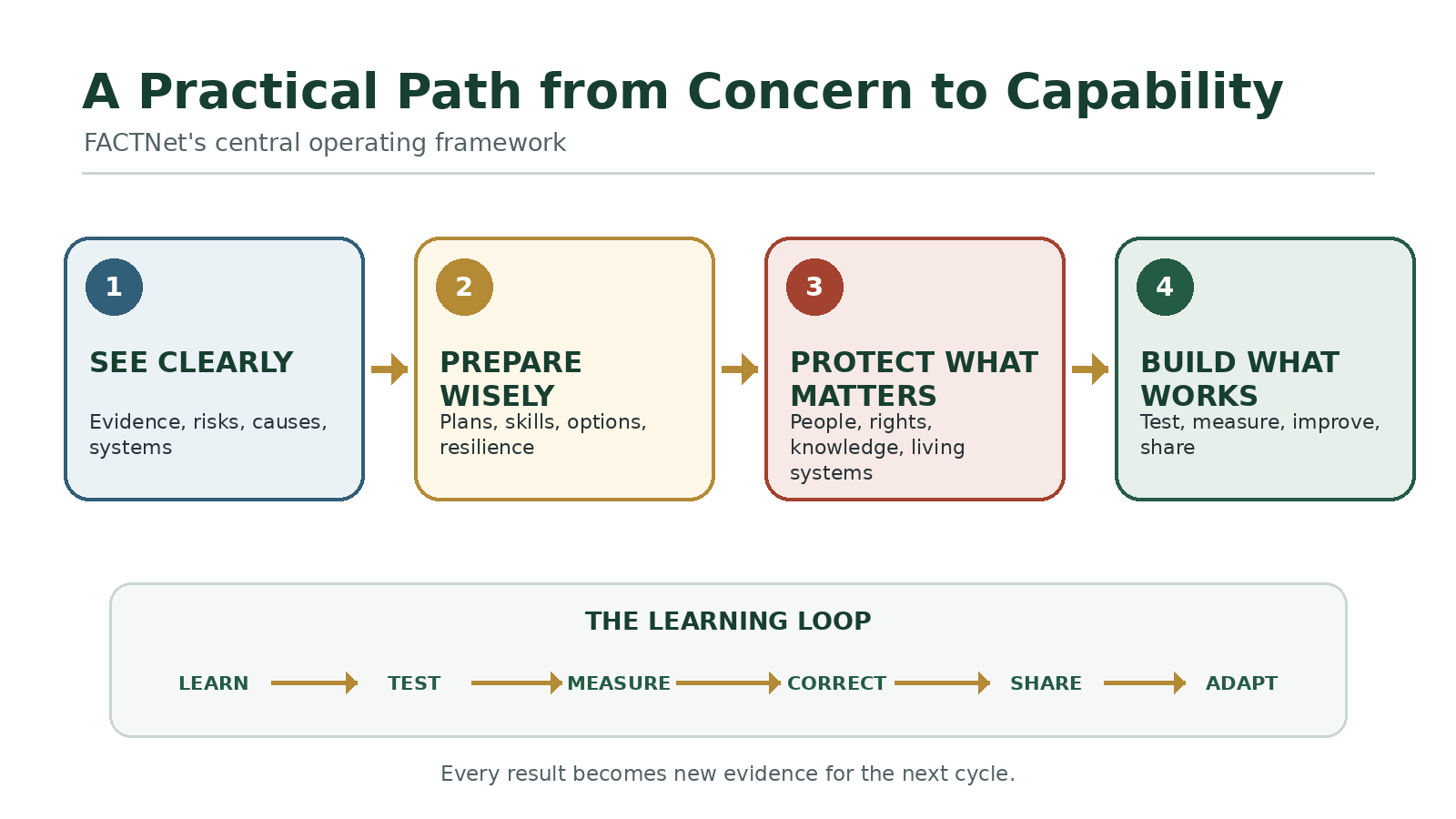
- Learn from evidence, experience, local knowledge, and responsible disagreement.
- Prepare people and communities without spreading panic.
- Protect life, dignity, rights, knowledge, freedom, and living systems.
- Build and test useful projects, policies, practices, and institutions.
- Measure results, disclose failure, correct mistakes, version improvements, and share what works.
Safeguards against misuse
- Not a political party, religion, sect, closed ideology, or loyalty test.
- No founder, donor, charismatic leader, expert, spiritual teacher, or organization is above evidence, accountability, appeal, or correction.
- Spiritual and metaphysical exploration remains voluntary and must not replace science, healthcare, rights, consent, or reality testing.
- No promise that progress is automatic, inevitable, or directed by a chosen elite.
- No devaluing people who do not join, use our language, or agree with every conclusion.
Voluntary, pluralistic, evidence-responsive, and open to contribution
The network does not require one political, religious, spiritual, or philosophical worldview. It requires enough shared commitment to learn honestly, protect equal human dignity, cooperate on real problems, and improve when credible evidence or results challenge a favored idea.
What is an Evolutioneer?
An Evolutioneer is a person committed to continuous learning, reality-based and metasystemic thinking, responsible preparation, protection of human dignity and living systems, practical contribution, and correction through results.
The identity connects the Great Reckoning with the Great Rebirth: an Evolutioneer is willing to recognize serious problems, learn from them, develop useful capabilities, and apply that learning to constructive renewal.
Practice before identity
Problem → Learning → Capability → Contribution → Optional Identity
You do not have to call yourself an Evolutioneer to participate. The word is an invitation and direction of practice—not a rank, doctrine, superiority claim, spiritual attainment, moral badge, or test of human worth. Contribution matters more than adopting a label.
You may already be doing this work if you are preparing responsibly, protecting people or ecosystems, improving institutions, teaching useful skills, strengthening community, correcting mistakes, creating meaning and joy, or leaving better options to those who come after you.
4. One Mission, Four Public Doorways
FACTNet is the nonprofit umbrella connecting a four-website public-education pathway. People can enter through the need that matters most and move among the sites as their questions and capacities develop.
Survive and Stabilize → Think Clearly → Live Wisely → Mean Deeply

This is a pathway, not a ladder. No doorway is “higher,” and no visitor must use all four.
Job One for Humanity
Survive and stabilize. Understand climate realities and deadlines; reduce climate risk; and prepare for adaptation, resilience, migration, and protection of essential systems.
Universe Institute
Think clearly. Understand the global polycrisis; use rational and systems thinking; learn Dialectical Metasystemic Analysis and Problem-Solving (DMAP), including Laske's 28 thought forms; and develop wiser judgment about AI and civilization.
The Way of the Universe
Live wisely. Explore a secular practical philosophy aligned with reality, evolution, ecological limits, Right Actions, Right Attitudes, responsibility, and the common good.
Universe Spirit
Mean deeply. Explore wonder, belonging, inner resilience, and healthy, non-dogmatic spiritual or existential inquiry without surrendering critical thinking, consent, balance, pluralism, or freedom.
Planned and developing projects also include structured learning through Universe College; land-based community, research, and demonstration through Universe One; climate-prepared regions and migration support through CCPARM; local beacons that preserve knowledge and test practices; and interviews with researchers, educators, practitioners, community leaders, and trusted communicators who can introduce this work to larger audiences.
5. If You Read Only One Analytical Section, Read This
The positive destination and ways to participate are now clear. Here is the candid six-point overview of why the work matters.
1. Humanity is entering a period of unusually high systemic risk. Climate destabilization, ecological degradation, biodiversity loss, resource overshoot, population and consumption pressures, inequality, political polarization, misinformation, war, economic fragility, technological disruption, and weakening institutions can interact and amplify one another.
2. Serious collapse is possible, but collapse is not one event and not a scientifically fixed destiny. Particular governments, economies, infrastructure systems, communities, ecosystems, or regions may fail badly while others adapt, reorganize, reform, or recover.
3. We do not have to wait for collapse to begin the Great Rebirth. Every successful transition to cleaner energy, ecological restoration, better governance, wiser population policy, stronger community resilience, more accountable institutions, healthier economic incentives, better thinking, and more durable cooperation is already part of the Great Rebirth.
4. Preparation is not surrender. Preparing for climate and polycrisis disruption can reduce suffering, save lives, protect vulnerable people, preserve essential knowledge, and keep more future options open. Mitigation and adaptation belong together.
5. Hope is not a forecast. Practical hope means acting intelligently without requiring a guarantee of success. We can reduce harm, preserve what matters, learn from failure, and improve the odds of better outcomes even when we cannot control the whole system.
6. Humanity's Great Rebirth is a design challenge. Its central question is: What kinds of cultures, economies, communities, governments, technologies, and institutions can live within ecological limits while protecting dignity, freedom, fairness, cooperation, knowledge, and the wellbeing of future generations?
The Great Rebirth does not begin after history breaks. It begins today anywhere people face reality, reduce avoidable harm, preserve what is worth saving, and build something better.
6. The Candid Truth: Collapse Is a Serious Option, Not a Fixed Future
In the past, we stated that existing economic, social, and political systems would resist necessary changes until they collapsed, followed by mass extinction, a possible Dark Age lasting decades or centuries, and eventual rebuilding by prepared survivors.
That is one severe pathway worth studying and preparing for. It is not the only pathway, and we should not present it as predetermined.
Complex societies rarely change everywhere at once. A more realistic approach examines overlapping pathways that can occur simultaneously in different places.
Reform and Accelerated Transition
Governments, communities, businesses, and civil society make enough early changes to reduce major risks, decarbonize faster, restore ecosystems, improve resilience, reform incentives, and avoid the worst forms of breakdown.
Managed Simplification and Uneven Adaptation
Some high-cost, fragile, or ecologically destructive systems contract while societies deliberately preserve critical medicine, science, rights, infrastructure, food systems, education, communication, and governance capacity.
Regional and Institutional Breakdown
Some nations, cities, markets, infrastructure systems, or ecosystems suffer serious failures, migration, conflict, or loss of state capacity while other regions remain functional and become centers of adaptation and recovery.
Cascading Widespread Collapse
Climate, food, water, energy, financial, political, conflict, ecological, and public-health shocks reinforce one another and overwhelm multiple systems at once, producing severe mortality, displacement, authoritarian responses, and long recovery periods.
The practical lesson is not to guess which single scenario will occur and then emotionally marry it. The wiser approach is to reduce the probability of the worst pathways while preparing for a wide range of disruptions.
A necessary correction to an old claim
Earlier research described global civilizational collapse and possible human extinction within roughly three to seven decades as though this were an established scientific fact and forecast. It is not.
Climate change and ecological degradation create severe and increasing risks, including the possibility of cascading social, economic, and political disruption. But neither the IPCC nor the broader scientific literature establishes one timetable on which global civilization must collapse or humanity must become extinct.
This correction does not mean there is little to worry about. It distinguishes serious risk analysis from certainty. That makes preparation more credible—not less urgent.

The Great Reckoning and the Great Rebirth overlap
The Great Reckoning is our name for the period in which delayed, deferred, and denied accumulated ecological, climatic, economic, political, technological, and social consequences become increasingly difficult to ignore or postpone. The Great Rebirth is the constructive response: learning, adapting, preserving, repairing, simplifying where necessary, and creating better systems.
One community may already be rebuilding soil, water systems, food security, local governance, and mutual aid while another region moves deeper into instability. History, irritatingly, refuses to organize itself into neat chapters.
7. The Deep Causes the Great Rebirth Must Address
We cannot build a durable future by treating only surface symptoms. Climate change is directly driven by greenhouse-gas emissions, especially fossil-fuel burning, but the structures producing those emissions are embedded in deeper economic, cultural, demographic, institutional, technological, and psychological systems.
Eight deep causes of the Great Reckoning deserve special attention.
Human societies can demand more biological regeneration, material throughput, waste absorption, fresh water, fertile soil, fisheries, forests, minerals, and climate stability than ecosystems can sustainably provide. Overshoot is not merely a moral failure. It is a physical relationship among demand, regeneration, substitution, depletion, waste, and system limits.
Total environmental pressure depends on more than population alone. It also depends on per-person consumption, technology, inequality, waste, production systems, energy sources, land use, distribution, and governance. A sustainable future therefore requires humane attention to demographic trends and excessive consumption—especially high-impact consumption.
Many cultures and institutions have acted as though human economies sit above or outside the ecological systems supporting them. The Great Rebirth requires a more accurate worldview: economies are subsystems of societies, and societies are subsystems of the biosphere.
Many institutions allow private actors to keep profits while transferring pollution, ecological damage, health costs, climate risk, depletion, and long-term liabilities onto the public, ecosystems, poorer communities, or future generations. A durable society cannot make betrayal of the future a profitable business model.
Humans respond strongly to immediate threats, status, coalitions, scarcity, and near-term rewards. Slow systemic dangers are harder to perceive and organize around. Our psychology contains cooperation and care, but also self-interest, denial, free-riding, dominance, tribalism, and motivated reasoning. Good systems must work with the animal we actually are—not the flattering brochure version.
Powerful actors can delay reforms that impose costs on them, manipulate public information, influence regulation, and shape institutions for private advantage. The Great Rebirth therefore needs transparency, independent oversight, accountability, anti-capture protections, and stronger public resistance to misinformation and disinformation.
Complex societies require energy, administration, infrastructure, expertise, coordination, information processing, enforcement, and maintenance. Added complexity can solve real problems, but it also creates overhead and failure modes. When complexity becomes too costly relative to its benefits, societies become brittle.
Climate change, biodiversity loss, pandemics, financial contagion, migration, nuclear risk, artificial intelligence, ocean degradation, and resource systems cross national boundaries. Local autonomy matters, but problems crossing borders require effective cooperation at the same scale.
The Great Rebirth must address both causes and consequences. If we address climate change while leaving destructive incentives untouched, another problem may replace it. If we reform institutions while ignoring ecological limits, physical reality eventually wins the argument. It has home-field advantage.
8. Overshoot, Carrying Capacity, Population, and Sustainable Prosperity
Overshoot occurs when demand on a renewable resource or regenerative system exceeds the rate at which that resource or system can recover. At the planetary scale, related pressures include greenhouse-gas accumulation, habitat loss, freshwater stress, nutrient-cycle disruption, soil degradation, overfishing, deforestation, pollution, and excessive material throughput.
Why one carrying-capacity number is misleading
Earlier work cited estimates suggesting an Earth carrying capacity of approximately 1.5–2 billion people. There is no single scientifically accepted global figure. Estimates vary enormously with diet, technology, energy systems, inequality, consumption, ecosystem health, trade, agriculture, acceptable living standards, and how much habitat and biological productivity humanity leaves for other species.
The underlying relationship remains critical: population, consumption, and technology multiply one another. The United Nations' 2024 population revision estimated about 8.2 billion people in 2024 and projected a peak near 10.3 billion in the mid-2080s before gradual decline. Lower fertility is encouraging, but population stabilization alone will not end ecological overshoot if per-person impacts remain too high.
A humane population strategy
Population policy must respect human rights and bodily autonomy. Defensible approaches emphasize voluntary family planning, universal access to contraception and reproductive healthcare, education and opportunity for girls and women, child survival, poverty reduction, informed reproductive choice, and social conditions in which people do not need large families as insurance against insecurity.
Coercive reproductive policy would contradict the Great Rebirth's rights, dignity, consent, and anti-coercion principles.
Sustainable Prosperity
The opposite of overshoot is not universal poverty. It is prosperity designed to remain inside ecological limits while meeting human needs and protecting the regenerative capacity of natural systems.
FACTNet and Job One for Humanity use Sustainable Prosperity for this goal. It means moving away from success measured mainly by ever-increasing material throughput and toward wellbeing that improves health, security, education, community, ecological quality, meaningful work, fairness, resilience, and quality of life without requiring endless extraction and waste.
Read the Job One for Humanity Sustainable Prosperity material.
9. A Simple Thought Experiment: Two Communities, One Shock
The difference between passive hope and practical hope becomes easier to see when two communities face the same disruption.

Community A: Wait for Normal to Return
A severe multi-year drought hits. Water prices rise. Food becomes more expensive. Insurance retreats. The electric grid becomes less reliable during heat waves.
The community assumes higher levels of government will solve everything. Political factions blame one another. Wealthier residents hoard private solutions. Lower-income households absorb the greatest losses. Local institutions have little reserve capacity, few trusted communication networks, and no agreed emergency priorities.
When a second shock arrives, the first crisis has already weakened trust and public finances.
Community B: Prepare, Adapt, and Cooperate
The same drought hits. This community has diversified water supplies, improved efficiency, restored watersheds, expanded local food capacity, strengthened cooling centers, created mutual-aid networks, installed distributed renewable energy and backup systems, protected vulnerable residents, and rehearsed emergency plans.
It still suffers. Resilience is not a force field. But fewer people are harmed, recovery is faster, public trust is higher, and the community learns from the event instead of merely surviving it.
That difference is the Great Rebirth in miniature: earlier learning and cooperation preserve more lives, trust, capacity, and future options.
10. What Good Government Looks Like in the Great Rebirth
A resilient government must do more than hold elections or enforce order. It must create enough public value that people see continued cooperation with the system as legitimate and worthwhile.
The core functions of legitimate, resilient government
Common Purpose and Public Legitimacy
Government should articulate widely defensible public goals while preserving pluralism and individual rights. Legitimacy grows when institutions solve real problems fairly, explain decisions honestly, and remain accountable.
Education and Collective Intelligence
Societies need citizens who can evaluate evidence, understand shared risks, resist manipulation, cooperate across differences, and acquire skills for changing conditions.
Critical Infrastructure
Water, sanitation, waste systems, energy, communications, transportation, public spaces, and other infrastructure are basic foundations of complex society.
Health and Human Development
Basic public health, disease prevention, emergency medicine, child wellbeing, and social conditions supporting human development are not luxuries. They are resilience infrastructure.
Food, Logistics, and Strategic Reserves
Governments and communities need systems for moving, storing, and distributing food and other essentials, including prudent reserves for emergencies and supply disruptions.
Law, Justice, Rights, and Internal Order
Police, courts, dispute resolution, due process, anti-corruption systems, civil rights, property and contract rules, and fair enforcement are necessary for cooperation at scale.
External Defense and Risk Protection
Societies must protect people from external threats while preventing security systems from becoming permanent mechanisms for domination, secrecy, or unaccountable power.
Emergency Response and Recovery
Governments should maintain temporary emergency services, reserves, mutual-aid agreements, recovery capacity, public reporting, and strict limits on emergency powers.
Culture, Art, Meaning, and Social Cohesion
Societies are not only supply chains with flags. Art, culture, history, ritual, public memory, recreation, and shared meaning help people maintain identity, dignity, joy, and solidarity under stress.
Ecological Stewardship
Government must protect the climate, ecosystems, waters, soils, forests, biodiversity, and resource base on which every other public function ultimately depends.
The conflict and integration functions of government
One broad theory emphasizes conflict: states can protect elites, concentrate wealth, control populations, and institutionalize coercion. Another emphasizes integration: states coordinate complex societies, manage shared infrastructure, resolve disputes, organize trade, provide security, and solve problems smaller groups cannot solve alone.
Both perspectives identify real functions. Governments can integrate society and become captured by powerful interests. The Great Rebirth therefore needs public institutions strong enough to solve large-scale problems and constrained enough to prevent domination.
Both-and governance
We need capable government and limits on government; expert administration and democratic accountability; efficient coordination and local autonomy; emergency capacity and strict safeguards against emergency powers becoming permanent. We need leaders compensated enough to attract competence and prevented from converting public authority into private enrichment.
Complexity has costs
As societies become more complex, they require more coordination, information processing, administration, maintenance, security, infrastructure, and specialization. Added complexity can produce enormous benefits, but its marginal benefits may decline while costs continue rising.
The lesson is not that bureaucracy or government should disappear. Complex systems need coordination. The challenge is to keep necessary complexity efficient, legitimate, transparent, adaptive, and proportionate to the benefits it produces.
Tightly coupled systems also create new risks. When more components depend on one another, failures can cascade. Resilience therefore often requires modularity, redundancy, reserves, diversity, backup capacity, and the ability to simplify gracefully rather than fail catastrophically.
Ecological surplus and democracy
Political freedom and social stability become harder to maintain when basic resources are chronically scarce, public institutions are overwhelmed, and distributional conflicts intensify. The Great Rebirth therefore treats ecological stability and adequate shared resources as part of the material foundation for durable democratic institutions.
11. Fourteen Design Principles for the Great Rebirth
A vision becomes useful when it survives contact with incentives, institutions, scarcity, power, and ordinary human behavior. These principles turn positive language into a testable design framework. They are guides for learning—not purity tests.
Protect the regenerative systems that make all economies and societies possible.
Mitigation and adaptation are complementary—not competing—strategies.
Decision-makers should bear meaningful responsibility for harms and costs they create instead of exporting them to the public, ecosystems, or future generations.
Align status, compensation, and institutional rewards more closely with public value rather than extraction, rent-seeking, manipulation, or inherited privilege.
Cooperation becomes fragile when contributors repeatedly absorb costs while exploiters take benefits without fair contribution.
Shared resources require measurement, monitoring, fair rules, credible enforcement, transparency, appeal, and adaptive management.
No corporation, government agency, donor, founder, expert group, religious body, political faction, or charismatic leader should become effectively unaccountable.
Keep decisions local when local action is sufficient. Coordinate regionally, nationally, or globally when the problem crosses those boundaries.
Crisis is not an excuse to erase dignity, pluralism, bodily autonomy, due process, consent, privacy, or the freedom to question institutions.
Maximum short-term efficiency can create maximum brittleness. Critical systems need backups, diversity, and slack.
Science, medicine, engineering, agriculture, law, history, literature, art, practical skills, and institutional memory are survival and renewal resources.
No model, ideology, institution, leader, or plan should be protected from disconfirming evidence. Publish important changes and explain why they were made.
Individual rights and community responsibilities. Local resilience and global cooperation. Technology and ecological restraint. Preservation and intelligent simplification. Markets and public safeguards.
Long-term costs should not be hidden because the people paying them cannot yet vote, sue, buy advertising, or attend a board meeting.
The Universe Principles of Right Action and Right Attitude provide a practical, day-to-day companion to these civilizational principles. They focus on better decisions, cooperation without naivety, rights and responsibilities, resilience, feedback, and conduct that improves long-run outcomes.
Read the Universe Principles of Right Action and Right Attitude.
12. What Can You Actually Do?
One dangerous effect of global-scale thinking is the belief that because you cannot control the whole system, nothing you do matters. That conclusion does not follow.
Your influence is limited. It is not zero.
Prepare and Adapt
- Learn your local climate, water, food, fire, heat, flood, insurance, health, and infrastructure risks.
- Build emergency supplies and backup capacity appropriate to actual risks.
- Strengthen household finances and reduce unnecessary vulnerabilities.
- Plan relocation or managed retreat if your location becomes unsafe or economically untenable.
Build Relationships Before You Need Them
- Know your neighbors.
- Strengthen family and friendship networks.
- Support local mutual aid, emergency response, food systems, and community organizations.
- Practice cooperation and conflict resolution while conditions remain relatively stable.
Improve How You Think
- Learn rational analysis, systems thinking, basic probability, and—where useful—DMAP and Laske's 28 thought forms.
- Distinguish evidence from confidence theater.
- Search for counterevidence and the strongest opposing case.
- Watch for false either-or framings.
- Update beliefs when reality disagrees.
Use Your Civic and Professional Influence
- Support climate mitigation and adaptation.
- Defend accountable democratic institutions and civil rights.
- Promote anti-corruption and anti-capture safeguards.
- Improve the resilience and ethics of organizations in which you have real influence.
Preserve What Is Worth Preserving
- Practical and vocational skills.
- Scientific, technical, medical, and agricultural knowledge.
- Seeds, biodiversity, libraries, art, and cultural memory.
- Democratic practices and human-rights traditions.
Help Build Better Models
- Resilient communities and mutual-aid systems.
- Regenerative food, water, and ecological systems.
- Distributed energy and reliable critical infrastructure.
- New education systems and knowledge-preservation projects.
- Accountable governance and social enterprises aligned with ecological reality.
Why try if the odds are uncertain?
- Meaning: Protecting life, people, knowledge, and a viable future can give direction and purpose even when outcomes are uncertain.
- Right action: Reducing avoidable harm and protecting others can be worthwhile even when success is not assured.
- Future generations: Saving some people, ecosystems, institutions, knowledge, and beautiful parts of civilization is better than preserving none of them.
13. Evidence Standards, Red-Teaming, and Self-Correction
A credible Great Rebirth framework must distinguish kinds of claims, invite serious objections, and change when evidence changes. Positive purpose is strengthened—not weakened—by epistemic humility.
Well-supported findings such as human-caused climate warming, greenhouse-gas accumulation, biodiversity decline, and human dependence on ecological and physical foundations.
A conditional result whose outcome depends on stated assumptions, scenarios, inputs, structure, and uncertainty ranges.
An important pattern with meaningful support but continuing uncertainty about timing, magnitude, interaction, thresholds, or local consequences.
A plausible high-impact future used for preparation without being presented as inevitable or precisely timed.
A systems-and-dialectical interpretation intended to expose processes, relationships, contexts, contradictions, and transformations—and generate questions that can be tested.
A stated value or proposed institution that should be tested against outcomes, unintended consequences, incentives, capture risks, rights, and reasonable alternatives.
Operating safeguards for the Great Rebirth Network
- Evidence: Link important factual claims to sources and distinguish observation from inference.
- Objections: Present the strongest serious counterarguments—not convenient weak versions.
- Red teams: Invite ecological, economic, political, civil-liberties, Indigenous, technological, disability-access, and local-knowledge critiques.
- Versioning: Date major analyses and explain significant corrections or reversals.
- Anti-guru accountability: No founder, leader, donor, expert, or spiritual teacher is exempt from questions, transparent governance, conflict-of-interest rules, or removal procedures.
- Spiritual hygiene: Keep metaphysical exploration voluntary; protect consent and boundaries; never use transcendent claims to override evidence, healthcare, rights, finances, or personal autonomy.
Reality-responsiveness is part of the movement's identity. When credible evidence or results challenge a favored idea, the Great Rebirth response is to learn, document the change, and improve.
14. AI Prompts to Test, Challenge, and Apply the Great Rebirth
Use AI as a research and thinking tool—not as an electronic oracle wearing a confident typeface. Require sources, counterevidence, uncertainty, explicit assumptions, and a clear separation between evidence and inference.
1. Test the collapse thesis:
“Evaluate the strongest scientific and historical evidence for and against widespread global civilizational collapse during the 21st century. Analyze climate risk, ecological overshoot, resource depletion, economic fragility, governance failure, war, and technological risks separately and in combination. Distinguish consensus findings, plausible scenarios, disputed claims, and speculation. State what evidence would change each conclusion.”
2. Red-team the Great Rebirth:
“Evaluate Humanity's Great Rebirth as a civilizational design framework. Test it for ecological realism, free-rider problems, elite capture, authoritarian risk, incentives, consequence capture, rights, pluralism, commons governance, economic feasibility, feedback quality, knowledge preservation, and intergenerational justice. Give the strongest objections and improvements.”
3. Test overshoot claims:
“Compare the strongest current research on ecological overshoot, planetary boundaries, material throughput, population, consumption, carrying capacity, and technological substitution. Explain which claims are well supported and which depend heavily on assumptions.”
4. Analyze my community:
“Create a climate and polycrisis resilience audit for [CITY OR REGION]. Examine heat, fire, flood, water, food, energy, health, insurance, housing, migration, infrastructure, fiscal capacity, political stability, and supply chains. Rank risks by probability, severity, time horizon, and controllability. Recommend mitigation, adaptation, preparedness, and managed-retreat options.”
5. Find both-and solutions:
“Identify false either-or choices in this proposal. Where feasible, redesign them as both-and strategies, especially mitigation and adaptation, individual rights and shared responsibilities, markets and regulation, local autonomy and global coordination, efficiency and redundancy, technology and ecological restraint, preservation and simplification.”
6. Audit a proposed resilience community:
“Red-team this eco-community or resilience-community proposal for coercion, financial conflicts, free-riding, commons failure, discrimination, privacy violations, leader capture, emergency-power abuse, weak grievance procedures, unrealistic resource assumptions, and cultic dynamics. Recommend concrete safeguards before recruitment begins.”
7. Challenge my preferred evidence:
“Assume I may be wrong. Find the highest-quality counterevidence to the major claims on this page. Prefer primary studies, scientific assessments, systematic reviews, and official datasets. Explain disagreements in methods and assumptions rather than merely counting sources.”
8. Audit the movement itself:
“Evaluate this Great Rebirth Network proposal for founder control, donor capture, ideological conformity, spiritual manipulation, status hierarchy, mission drift, burnout, exclusion, misinformation, and failure to disclose corrections. Recommend governance, transparency, appeals, versioning, and accountability safeguards.”
15. Frequently Asked Questions
Is Humanity's Great Rebirth a prediction?
No. It is a possibility, aspiration, and design framework. It identifies directions that could improve humanity's chances of creating sustainable, resilient, cooperative societies. It does not claim that evolution or history guarantees success.
Could a Great Global Collapse still happen?
Yes. Severe regional or widespread collapse remains a serious risk pathway when climate, ecological, food, water, economic, conflict, public-health, and governance pressures interact. But collapse is not one uniform event, and we do not treat a specific global collapse date as scientifically established.
Must collapse happen before the Great Rebirth?
No. Reform, resilience, institutional redesign, ecological restoration, better governance, and new community models can begin now. Preventing unnecessary collapse is itself part of the Great Rebirth.
What about the old 1.5–2 billion carrying-capacity estimate?
Population pressure and carrying capacity remain important, but there is no single widely accepted global figure. Estimates depend heavily on diet, consumption, technology, agriculture, inequality, energy, ecosystem health, trade, and acceptable living standards. The wiser focus is reducing overshoot through humane population stabilization and lower high-impact consumption.
What about the study suggesting civilization had less than a 10% chance of surviving?
The 2020 Bologna and Aquino paper modeled relationships among deforestation, population, and civilization lifespan under specific assumptions. It is useful as a warning model but should not be treated as a consensus probability that civilization has a 90% chance of collapsing. It remains in the bibliography with that qualification.
Is this a call for forced population control?
No. Population policy should be humane, voluntary, evidence-based, and consistent with human rights. Education, reproductive healthcare, contraception, opportunity for women, poverty reduction, and informed family planning are legitimate approaches. Coercion is not.
Is the Great Rebirth anti-capitalist?
It criticizes systems that reward pollution, ecological destruction, monopoly power, unlimited throughput, political capture, and privatized gain combined with socialized harm. It does not require abolishing every market mechanism. Markets can be useful when rules capture externalities, prevent abuse, protect commons, maintain competition, and align incentives with long-term wellbeing.
Are you calling for world government?
Not necessarily one centralized world state. Problems should be governed at the smallest scale capable of solving them effectively. Some global problems require stronger international coordination, enforceable agreements, shared standards, and capable institutions. The challenge is effective global cooperation without unaccountable concentration of power.
Is technology part of the solution?
Yes, when it produces net benefits within ecological and social constraints. Clean energy, storage, efficient transport, water systems, monitoring, medicine, communications, agriculture, materials science, and AI can contribute. Technology is not magic; it can also create rebound effects, resource demand, pollution, surveillance, dependency, concentrated power, and new systemic risks.
What if I cannot influence national or global policy?
Focus on your sphere of influence: household preparedness, local resilience, professional ethics, community cooperation, reduced vulnerability, knowledge preservation, protection of vulnerable people, support for effective institutions, and decisions about where and how you live. You do not need control of the whole chessboard to make a useful move.
Is the Great Rebirth spiritual?
It can carry spiritual meaning for people who freely understand it that way, but the Great Rebirth Network is pluralistic and does not require metaphysical belief. The shared framework is practical: right action, resilience, ecological realism, cooperation, learning, dignity, and protection of freedom.
Must I call myself an Evolutioneer?
No. Evolutioneer is an optional, practice-based identity. No label, rank, spiritual status, membership, ideology, or purity test is required. Learning and useful contribution matter more than what you call yourself.
Is the Great Rebirth Network another organization?
No. FACTNet is a nonprofit organization. The Great Rebirth Network is the wider voluntary ecosystem of people, communities, organizations, and projects moving in a compatible constructive direction.
16. Glossary
Adaptation
Adjustments in behavior, planning, infrastructure, institutions, ecosystems, or economic activity that reduce harm or improve functioning under changing conditions.
Anthropocentrism
A human-centered worldview. In its extreme form, it treats other life and ecological systems mainly as resources for human use rather than living systems with independent value and critical life-support functions.
Carrying Capacity
The population or level of activity an environment can sustain over time under specified conditions. At a global human scale, estimates depend heavily on assumptions and should not be treated as one fixed number.
Collapse
A substantial loss of function, complexity, capacity, legitimacy, services, population, or ecological integrity. Collapse can be local, institutional, sectoral, regional, ecological, national, or much broader.
Commons
A resource or system shared by multiple users whose long-term wellbeing depends on rules, monitoring, fair contribution, and protection from overuse or capture.
Consequence Capture
The principle that consequential decision-makers should bear meaningful responsibility for the costs and harms their decisions create rather than exporting them to others.
DMAP
Dialectical Metasystemic Analysis and Problem-Solving: an advanced method for examining complex, changing systems through multiple processes, relationships, contexts, transformations, contradictions, perspectives, and scales.
Ecological Overshoot
A condition in which human demands on biological regeneration, waste absorption, materials, or Earth-system functions exceed sustainable regenerative or safe operating capacities.
Evolutioneer
An optional identity for a person committed to continuous learning, reality-based thinking, responsible preparation, protection of dignity and living systems, practical contribution, and correction through results.
Externality
A cost or benefit created by an activity but imposed on people or systems outside the transaction. Pollution and climate damage are classic negative externalities.
Great Rebirth Network
The broad, voluntary, pluralistic, and evidence-responsive network of people, communities, organizations, and projects helping better futures become more likely through learning and useful action.
The Great Reckoning
The period in which deferred, denied, or delayed accumulated climate, ecological, resource, economic, political, social, and technological consequences become increasingly difficult to postpone, deny, or externalize.
Humanity's Great Rebirth
A possible long-term process of preserving what is best in civilization while developing more sustainable, resilient, cooperative, just, accountable, ecologically compatible, adaptive, and life-affirming systems.
Managed Simplification
Deliberately reducing costly, fragile, unnecessary, or ecologically destructive complexity while preserving essential knowledge, rights, infrastructure, health, science, and governance functions.
Metanoia
A profound change of mind, orientation, or understanding. Here it refers to deep reassessment that can follow major experience or crisis.
Planetary Boundaries
A scientific framework for assessing major Earth-system processes and identifying ranges within which humanity has a greater chance of maintaining relatively stable planetary conditions.
Polycrisis
A condition in which major crises interact across systems and scales so their combined effects become more dangerous or difficult to manage than the crises considered separately.
Practical Hope
Hope expressed through realistic action rather than certainty about outcomes: reducing harm, preparing, preserving, adapting, cooperating, and building better options.
Progressive Evolution
The observation that some open subsystems under persistent energy gradients and enabling constraints show a statistical tendency for the upper envelope of complexity—and sometimes agency or information-processing capacity—to increase. The tendency is local, conditional, and reversible, not a guarantee of progress.
Resilience
The capacity of a person, community, ecosystem, institution, or other system to absorb disturbance, preserve critical functions, adapt, recover, and transform when necessary.
Sustainable Prosperity
Human wellbeing that can persist within ecological limits and support health, security, fairness, meaningful work, community, and quality of life without depending on unlimited material throughput.
Systemic Risk
The risk that failures or shocks in one part of a connected system spread through relationships and dependencies, degrading the larger system.
17. Bibliography and Evidence Base
Important evidence note: Humanity's Great Rebirth is a FACTNet and Way of the Universe synthesis and design framework. The studies below support components of the analysis. Their authors should not be represented as endorsing this framework, FACTNet's specific climate forecasts, the Great Rebirth Network, or any particular collapse scenario.
Climate Change, Mitigation, Adaptation, and Risk
- Intergovernmental Panel on Climate Change (IPCC). (2023). Climate Change 2023: Synthesis Report. Assesses observed climate impacts, future risks, mitigation, adaptation, climate-resilient development, and the importance of near-term choices. Original source.
- United Nations Environment Programme (UNEP). (2025). Emissions Gap Report 2025: Off Target. Reviews the gap between climate commitments and policies and pathways consistent with Paris temperature goals. Original source.
Planetary Boundaries, Ecological Overshoot, and Biodiversity
- Richardson, K., Steffen, W., Lucht, W., et al. (2023). “Earth beyond six of nine planetary boundaries.” Science Advances, 9(37), eadh2458. Original study.
- Steffen, W., Richardson, K., Rockström, J., et al. (2015). “Planetary boundaries: Guiding human development on a changing planet.” Science, 347(6223). Original study.
- IPBES. (2019). Global Assessment Report on Biodiversity and Ecosystem Services. Assesses biodiversity loss, ecosystem degradation, drivers, risks to human wellbeing, and transformative-change options. Original source.
- Steffen, W., Broadgate, W., Deutsch, L., Gaffney, O., and Ludwig, C. (2015). “The trajectory of the Anthropocene: The Great Acceleration.” The Anthropocene Review, 2(1), 81–98. Original study.
Population and Demographic Change
- United Nations Department of Economic and Social Affairs, Population Division. (2024). World Population Prospects 2024. Provides the United Nations' major global demographic projections, including an estimated 2024 population of about 8.2 billion and a projected peak around 10.3 billion in the mid-2080s. Original source.
Resilience, Cascades, and Social-Ecological Systems
- Walker, B., Holling, C. S., Carpenter, S. R., and Kinzig, A. (2004). “Resilience, adaptability and transformability in social-ecological systems.” Ecology and Society, 9(2), 5. Original study.
- Folke, C. (2006). “Resilience: The emergence of a perspective for social-ecological systems analyses.” Global Environmental Change, 16(3), 253–267. Original study.
- Rocha, J. C., Peterson, G., Bodin, Ö., and Levin, S. (2018). “Cascading regime shifts within and across scales.” Science, 362(6421), 1379–1383. Original study.
- Haldane, A. G., and May, R. M. (2011). “Systemic risk in banking ecosystems.” Nature, 469, 351–355. Explores how complexity, connectivity, and ecological concepts illuminate systemic financial risk. Original study.
Commons, Cooperation, and Governance
- Ostrom, E. (2009). “A general framework for analyzing sustainability of social-ecological systems.” Science, 325(5939), 419–422. Original study.
- Dietz, T., Ostrom, E., and Stern, P. C. (2003). “The struggle to govern the commons.” Science, 302(5652), 1907–1912. Original study.
- Tainter, J. A. (1988). The Collapse of Complex Societies. Cambridge University Press. A major historical theory of societal complexity, problem-solving costs, declining marginal returns, and collapse. Publisher source.
The Original Page's 2020 Collapse Model, With Qualification
- Bologna, M., and Aquino, G. (2020). “Deforestation and world population sustainability: a quantitative analysis.” Scientific Reports, 10, 7631. This paper modeled relationships among deforestation, population, and civilization lifespan under specific assumptions. It is retained because it was an important source on the original page, but it should not be represented as a scientific consensus estimate that civilization has a 90% probability of collapsing. Original study.
Energy Transition and Employment
- International Renewable Energy Agency (IRENA) and International Labour Organization (ILO). (2026). Renewable Energy and Jobs: Annual Review 2025. Reports at least 16.6 million renewable-energy jobs worldwide in 2024 and reviews employment trends and transition policy. Original source.
Related FACTNet and Four-Website Materials
- Job One for Humanity: Global Climate and Polycrisis Risk Analysis
- Job One for Humanity: Climate Tipping Points
- Job One for Humanity Plan B: Preparation, Adaptation, Resilience, and Action
- Job One Plan Part 1: Emergency Preparation
- Job One Plan Part 2: Adaptation and Resilience
- Sustainable Prosperity and the Deep Causes of Environmental Destabilization
- Job One for Humanity: Current Fossil-Fuel Reduction Target Analysis
- The Way of the Universe
- Universe Institute
- Universe Spirit
18. Original-Page Source Links Preserved for Editors
This editor-oriented section preserves the major source pathways from the old Great Global Rebirth page so useful material is not lost during migration. It can be shortened only after all material has been moved to final destinations and every replacement link has been tested.
- Original published Great Global Rebirth page
- Universe Principles of Right Action and Right Attitude
- Job One global crises, collapse, and polycrisis page
- Job One climate tipping points
- Job One Plan Part 1
- Job One Plan Part 2
- Current Job One Plan B
- Sustainable Prosperity booklet
- Job One fossil-fuel reduction target analysis
19. Where to Go Next
If this page provides the Great Rebirth's long-range positive direction, the next step is choosing the practical doorway that best matches your present need.
For immediate climate preparation
Use Job One for Humanity for climate risk, mitigation, adaptation, resilience, migration, and protection of essential systems.
For better analysis
Use Universe Institute for the global polycrisis, rational thinking, systems theory, DMAP, Laske's 28 thought forms, and responsible AI-supported inquiry.
For practical philosophy and conduct
Use The Way of the Universe for Right Actions, Right Attitudes, responsibility, cooperation without naivety, resilience, feedback, and choices that improve long-run outcomes—less waiting for humanity to become enlightened, more learning how to behave usefully on Tuesday.
For meaning and inner resilience
Use Universe Spirit for wonder, purpose, grief, joy, inner development, and healthy, non-dogmatic spiritual or existential inquiry with explicit safeguards for consent, critical thinking, and freedom.
Future phases also include courses, interviews with researchers and trusted public communicators, Universe College learning programs, Universe One land-based demonstrations, CCPARM climate-prepared regions, and local knowledge-preserving beacons.
20. The Future Is Not Fixed
Humanity may face severe climate, ecological, economic, political, technological, and social disruptions during this century. Some communities and systems may fail. Some may adapt. Some may become more authoritarian. Some may become more cooperative. Some forms of complexity may be lost. Other forms may be preserved or rebuilt.
We cannot control every force shaping that future. We can influence the quality of our preparation, the amount of avoidable suffering, the resilience of our communities, the integrity of our institutions, the knowledge we preserve, the damage we stop adding, and the better systems we begin building.
That is enough reason to act.
We can face reality. Prepare and adapt. Protect life and freedom. Learn from consequences. Preserve what is best. Repair what can be repaired. Build what needs to be new. Keep working toward Humanity's Great Rebirth.
Showing 1 reaction